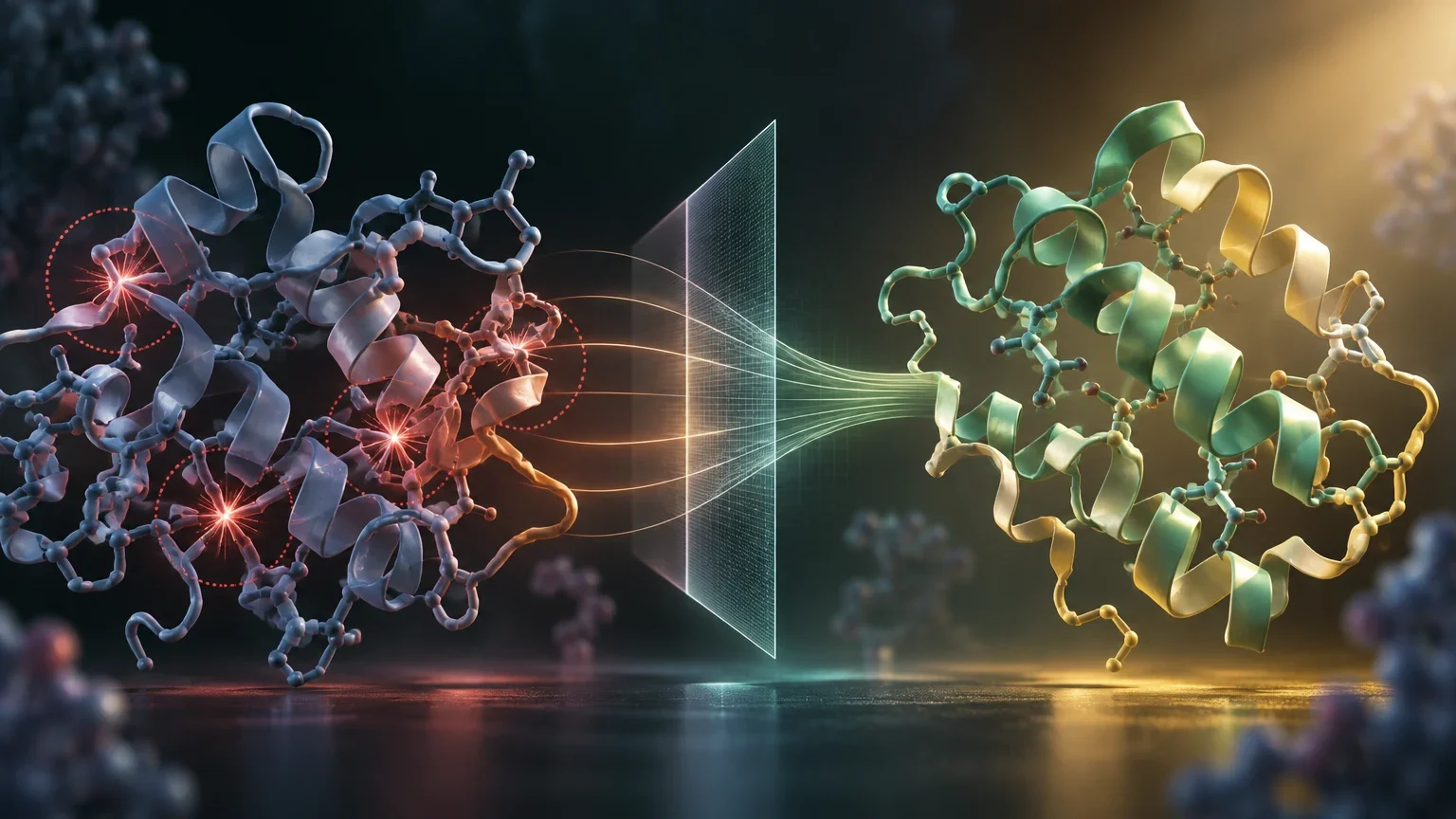
The physical validity problem in diffusion models
AlphaFold 3-style diffusion models are capable of predicting biomolecular complexes with high structural accuracy. However, a significant fraction of their outputs presents physical defects that make them invalid from a chemical and biological standpoint.
These defects include chain overlap at interfaces, distortion of ligand bond lengths and angles, non-planar rings, and the inversion of stereocenters. Although the global structure may appear correct, these errors prevent the prediction from being usable in subsequent simulations or experimental designs.
The distinction between an apparently plausible overall arrangement and physically consistent details is central to the problem described here. A predicted complex can look broadly well formed while still containing local clashes or chemically distorted ligand geometry. Those defects matter because downstream simulations and experimental designs rely not only on the global arrangement, but also on coordinates that respect the relevant physical constraints.
The listed defects affect different parts of a prediction. Chain overlap concerns the relationship between chains at their interfaces, while distorted bond lengths and angles, non-planar rings, and inverted stereocenters concern the ligand’s local geometry. Together, they show why structural accuracy alone does not guarantee that every output is suitable for later use. The concern is not that every prediction necessarily contains all these errors, but that a significant fraction may include physical defects despite an apparently correct global structure.
The proposal: inference-time projection
The preprint introduces an approach that treats physical validity as a constrained inference problem. Instead of retraining the model or adding costly physical potentials that increase memory and computation time, the authors propose applying closed-form projection operators to the clean coordinate estimate of the diffusion model.
This method is applied directly to the denoiser's output, leaving the neural network's weights intact. The main advantage is that it requires no additional network evaluations, gradients, or importance sampling, allowing it to be integrated into any AF3-style sampler without architectural modifications.
Treating physical validity as a constrained inference problem means addressing these defects during generation, rather than changing the model through retraining. The proposed correction acts on the clean-coordinate estimate produced by the diffusion model: it adjusts that estimate to meet physical constraints while leaving the neural network’s weights unchanged. In this way, the intervention is directed at the predicted coordinates, not at the learned parameters.
The authors describe the projection operators as closed-form and emphasize that their application does not require extra network evaluations, gradient calculations, or importance sampling. This distinguishes the proposed approach from options that add computationally costly physical potentials or require retraining. The stated compatibility with AF3-style samplers follows from applying the correction to the denoiser’s output without architectural modifications; it does not imply that every aspect of a sampler or prediction pipeline has been independently assessed.
In the proposed flow, coordinate generation comes first, followed by the inter-chain van der Waals projection and then the ligand distance-geometry projection. The result is described as a physically valid structure. This sequence clarifies the method’s intended role: it is a post-processing step within inference that addresses clashes between chains and ligand geometry after the model has produced its clean-coordinate estimate, rather than a replacement for the diffusion model itself.
Proposed method flow
1. The diffusion model generates a clean coordinate estimate. 2. The inter-chain van der Waals projection is applied. 3. The ligand distance-geometry projection is applied. 4. A physically valid structure is obtained.
- 01Coordinate generation by the diffusion model
- 02Application of van der Waals projection
- 03Application of ligand geometry projection
- 04Output of physically valid structure
Mechanics of the projection operators
The method uses two specific operators. The first is an inter-chain van der Waals projection that pushes apart the atom pairs with the most severe clashes. The second is a ligand distance-geometry projection that restores bond lengths, angles, internal contacts, planarity, and chirality.
Both operators are local, sparse, and displacement-capped. This means they only modify the coordinates necessary to satisfy physical constraints, minimizing the impact on the global structure predicted by the original model.
The two operators address complementary constraints. The inter-chain van der Waals projection targets the most severe clashes between atoms on different chains, pushing those pairs apart. The ligand distance-geometry projection instead restores the ligand’s internal geometry, including bonds, angles, contacts, planarity, and chirality. The division of tasks allows the approach to address both interface overlap and the local chemical defects described above without treating them as the same geometric problem.
Calling the operators local, sparse, and displacement-capped describes how the proposed corrections are limited. They are intended to act only on coordinates needed to satisfy physical constraints, rather than broadly reshaping the full structure. The displacement cap further limits how far coordinates are moved during correction. According to the authors’ rationale, these properties minimize the impact on the model’s global prediction; they should be understood as design features of the method, not as a guarantee that every corrected structure preserves all aspects of its original arrangement unchanged.
These operators therefore do not serve as a general claim that all possible physical or biological issues in a prediction have been resolved. Their specified scope is narrower: separating the most severe inter-chain clashes and restoring the listed ligand-geometry constraints. Keeping that scope clear helps distinguish the corrections the method is designed to make from broader questions about whether a structure is experimentally or biologically relevant.
Operator characteristics
Comparison of the two proposed projection operators.
| Operator | Function | Corrected constraints |
|---|---|---|
| Inter-chain van der Waals | Separate clashing atoms | Chain overlap |
| Distance geometry | Restore ligand geometry | Bonds, angles, planarity, chirality |
Declared experimental evaluation
The authors evaluate the method on two independently developed models: Boltz-2 and OpenFold-3. The evaluation is performed on five benchmarks: CASP15, CASP16, the PoseBusters monomer and complex sets, and the Boltz physical-validity test set.
According to the preprint, the method recovers perfect physical validity while preserving structural accuracy and ligand placement metrics. Furthermore, it is stated that these results are achieved with negligible runtime and memory overhead, suggesting practical viability for large-scale applications.
The evaluation is presented across two independently developed models, Boltz-2 and OpenFold-3, and five benchmarks: CASP15, CASP16, the PoseBusters monomer and complex sets, and the Boltz physical-validity test set. This spread is intended to assess the approach across different models and benchmark settings. The stated findings should nevertheless be read as results reported by the preprint’s authors, rather than as independently established conclusions.
The reported outcome is that the method recovers perfect physical validity while preserving structural-accuracy and ligand-placement metrics. These claims refer to the evaluated benchmarks and metrics; they do not establish that every prediction outside those tests will be corrected equally well. Likewise, the reported negligible runtime and memory overhead describes the authors’ evaluation of the method, and supports their suggestion of practical viability without, by itself, demonstrating performance in every implementation or setting.
Taken together, the evaluation is presented as evidence that inference-time projection can improve physical validity without sacrificing the measured structural and ligand-placement outcomes in the tests described. The significance of that result remains bounded by the benchmarks used and the status of the work as a preprint. Independent assessment would be needed before treating the reported performance as conclusive.
Limitations and final considerations
It is fundamental to highlight that this work is a preprint published on arXiv, meaning it has not yet undergone a formal peer-review process. The results presented are author declarations and require independent validation to be considered conclusive.
Additionally, a physically valid output does not by itself demonstrate the experimental or clinical utility of the structure. Independent biological validation remains a necessary step to confirm the relevance of these corrected predictions in real biomedical research contexts.
The preprint status is important when interpreting both the reported improvements and the claims about computational cost. The findings have not undergone formal peer review, and the experimental results have not been independently validated. Accordingly, the authors’ statements about perfect physical validity, preserved metrics, and negligible overhead should remain attributed to their report and be treated as provisional rather than conclusive.
Physical consistency is also distinct from biological or experimental usefulness. Correcting clashes or ligand geometry may address the specified structural defects, but it does not by itself establish that a predicted structure is biologically relevant or useful in experimental or clinical work. Independent biological validation remains necessary to assess that relevance; until then, the described corrections should not be taken as a substitute for such validation.
Open questions
- The work is a preprint and has not been peer-reviewed.
- No independent validation of the experimental results has been conducted.
- The experimental or clinical utility of the corrected structures is not demonstrated.
Keep exploring
Sources consulted
Corrections and transparency
If you spot incorrect or outdated information, send us a correction with the page and source we should review.
Submit a correction