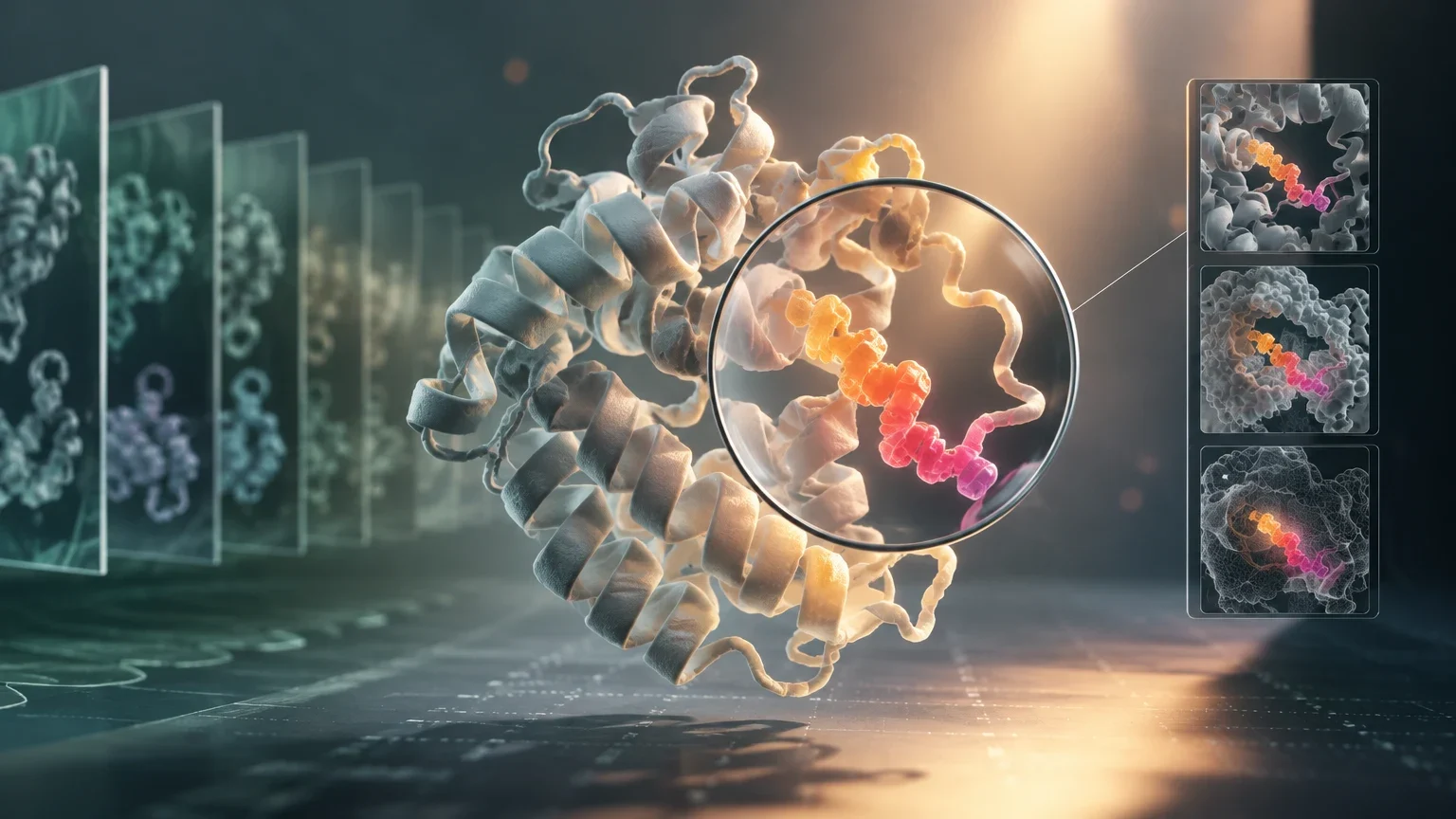
A provenance signal for biological designs
Google DeepMind introduced SynthID Bio as a proof of concept for identifying proteins and biological structures generated with artificial intelligence tools. The proposal adapts the idea of a detectable watermark to biology: rather than adding a separate label to a file, it embeds a signal in an amino acid sequence or in the coordinates of a predicted three-dimensional structure.
The aim is to provide a clue about the origin of certain designs. Such a clue could, for example, be useful when sequences are assessed for synthesis or when entries in scientific databases are reviewed. But a detectable mark is not a safety certification, nor does it establish by itself who commissioned or manufactured a molecule. The announcement describes an additional verification layer, not a universal traceability system.
Two methods for marking different kinds of data
In the sequence-based version, the system influences amino acid selection in a controlled way as a protein is generated. The signal is distributed across the sequence itself, rather than relying solely on metadata that can be detached from the design. A detector can then look for the pattern associated with the mark.
For predicted three-dimensional structures, the approach is different: part of AlphaFold 3’s diffusion network is adjusted so that the generated atomic coordinates carry a detectable signal. Google DeepMind says the mark is built into the adjusted model, rather than being only an annotation added afterward. These are not interchangeable ways of marking the same thing: one acts on amino acid sequences, and the other on coordinates in predicted structures.
What is marked and what the available evidence covers
A practical distinction between the two methods described. The table does not imply that either method alone certifies the complete provenance of a physical sample.
| Method | Where the signal is embedded | What the available evidence describes |
|---|---|---|
| Sequences | In amino acid selection during sequence generation. | Laboratory tests of marked binding designs for three targets. |
| Predicted structures | In atomic coordinates generated by an adjusted version of AlphaFold 3. | Evaluations of predicted structures and claims about detectability and retained accuracy. |
| Provenance metadata | In information associated with a design, as a possible complement. | Google DeepMind suggests it could be combined with watermarking; it is not itself the biological signal. |
What the laboratory tests show
Google DeepMind reports laboratory tests of protein designs intended to bind to three targets: VEGF-A, a binding region on the SARS-CoV-2 spike protein, and PD-L1. The company says that, under the conditions tested, marked designs matched unmarked versions in hit rate, binding affinity, and sequence diversity.
That result matters because a useful mark should not disable the molecule it is meant to identify. However, the conclusion must remain limited to those tests: the announcement does not show that every class of protein, design method, or production condition will preserve function. Nor does an evaluation of predicted structures amount to a laboratory test of manufactured proteins; these are evidence about different components of the proposal.
Scope: three targets, not every protein
The reported tests focused on three specific targets. They are an initial demonstration that some designs can be marked and their binding assessed in the laboratory—not a broad validation across all natural, synthetic, or therapeutic proteins. The documentation provided also does not offer a comprehensive assessment across all sequence lengths, protein families, or possible manufacturing processes.
The structural component was evaluated using AlphaFold 3 predictions. Google DeepMind says the method preserved prediction accuracy and that the signal held up against digital noise or minor changes to the coordinates. These claims concern the computational analysis described in the announcement. The available material does not provide independently verifiable quantitative results for detection or false positives, or a sufficiently detailed comparison to establish operational performance across different laboratories.
Potential uses and the limits of traceability
A provenance signal could help DNA synthesis providers or teams managing databases identify some marked designs and direct them toward additional review. It could also help prevent synthetic sequences from being mistaken for natural entries. These are proposed uses, not outcomes already demonstrated at general scale.
Google DeepMind acknowledges that resistance to deliberate tampering remains an open challenge. If a sequence is redesigned or modified, the mark may not survive. The presence of a signal can therefore provide evidence about provenance, but its absence does not prove that a sequence is natural or was not generated with AI. The company proposes combining the technique with metadata or other mechanisms and says that realizing its biosecurity benefits will require further research and collaboration.
How to interpret a mark without overclaiming
The signal should be treated as one piece of evidence to combine with other controls, not as an automatic decision about a sample’s risk.
- 01Establish whether the item being examined is an amino acid sequence or a predicted three-dimensional structure: the methods and tests are different.
- 02Check whether a detector identifies a signal and under what conditions, thresholds, and limitations. The information available here does not support quoting detection or false-positive rates.
- 03Interpret a detected signal as a provenance clue consistent with the method—not as a safety certificate, proof of authorship, or complete chain of custody.
- 04Do not treat the absence of a mark as proof of natural origin: resistance to deliberate alterations remains a recognized limitation.
What remains to assess real-world use
Assessing practical performance would require detailed experimental data on sensitivity, false positives, resilience to changes, and behavior across a wider range of sequences and structures. The primary information provided allows us to describe the announcement and the tests Google DeepMind reports, but it does not let us verify quantitative detection figures or independently compare the results with alternative methods.
The cautious conclusion is that SynthID Bio is an experimental marking proposal with promising initial results in the cases described. Its usefulness will depend on whether other teams can reproduce and expand the tests, whether detectors work under relevant conditions, and whether the signal can be integrated with other controls without being mistaken for a universal guarantee. Until then, it should be presented as a potential provenance layer whose scope and robustness remain to be established.
Open questions
- The scientific paper and an independently reviewable experimental report were not provided, so the announcement’s methods and results cannot be verified in detail here.
- The available primary documentation does not provide verifiable quantitative detection and false-positive rates.
- The coverage of protein classes, sequence lengths, experimental conditions, and analysis methods is not established as universal.
- Resistance to deliberate modifications remains a recognized challenge; robust traceability across all transformations has not been demonstrated.
Keep exploring
Sources consulted
Corrections and transparency
If you spot incorrect or outdated information, send us a correction with the page and source we should review.
Submit a correction