A Proposal to Connect Perception, Simulation, and Action
Google presents Gemini 4 Argon as a model capable of working with visual perception, 3D geometry, physical simulation, and robotic control. The robotics-focused publication gathers examples of these tasks rather than announcing a ready-to-install control system for any robot. It is best read as a series of provider demonstrations: it illustrates possible workflows but does not constitute an independent evaluation of its performance in varied environments.
The distinction matters because in robotics a plausible response is not enough. The system must perceive the state of the environment, produce safe actions, tolerate estimation errors, and verify the result via sensors. The published videos and instructions show concrete procedures, but the available information does not offer an independent and reproducible comparison that allows concluding that Argon generally outperforms traditional controllers.
Physical Reasoning and the ERQA Result
The publication describes ERQA as an evaluation of the understanding and resolution of physical and spatial problems in 3D environments. Google reports that Argon achieved 87% through pure reasoning without tools and claims it outperformed every other frontier model evaluated. The available material does not specify enough methodological details here—for example, the complete composition of the test, the evaluation configuration, and statistical uncertainty—to interpret that figure as a universal measure of robotic capability.
The physical reasoning shown combines visual observations with spatial information and hypotheses about contacts, movements, and object states. In a manipulation demonstration, the model can receive calibrated cameras, reference coordinates, and action primitives; in another example, it inspects intermediate images and proposes the next movement. This schema can help structure a task, although it does not by itself equate to a low-level controller or prove that the model has learned a general physical representation.
Simulation and Real2Sim Reconstruction
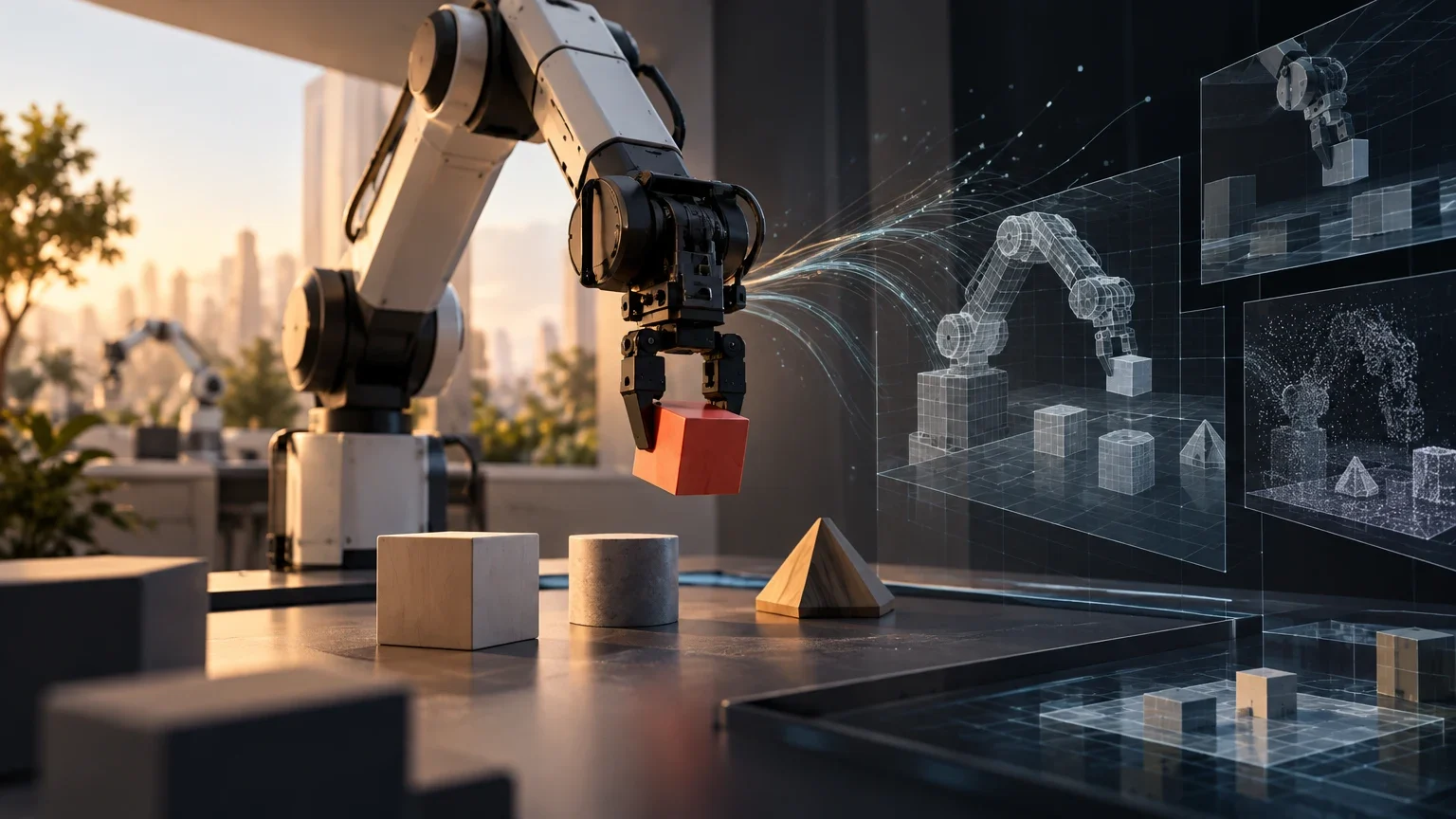
Among the demonstrations is the reconstruction of a simulation scene from robot data, human video, or even a sketch. Google describes an iterative process to tune the objects and the MuJoCo scene, with visual and physical objectives: comparing simulated views with real ones and approximating observed contacts. It also proposes practicing movements in simulation before executing them on the robot.
This approach relates to Real2Sim and Sim2Real: representing a physical scene in a virtual environment and using that representation to plan or test actions. The potential utility lies in rehearsing sequences and detecting problems before operating on hardware. However, the fidelity of a simulation depends on parameters such as geometry, mass, friction, joints, and calibration. The publication shows examples and tuning objectives, but it does not provide independent evidence that the procedure preserves that fidelity for a wide range of objects, robots, and conditions.
Workflow Illustrated by the Publication
The demonstration proposes a sequence of reconstruction and verification, not a guarantee of automatic transfer to the real world.
- 01Obtain video or sensor data from the episode and determine which objects and robot parts are relevant.
- 02Build a simulated scene with estimated geometry, joints, and physical properties.
- 03Compare simulated cameras and contacts with real records; review discrepancies.
- 04Test actions in simulation and, if transferred to hardware, verify the result with sensors and safety measures.
Manipulation: Demonstrations, Not a Promise of General Precision
The described examples include a quadruped robot with an arm that practices in MuJoCo before pressing a pedal and depositing a can; an arm that reorients a mug and places a napkin inside; and an iterative visual control that rearranges tiles. In these cases, Argon receives instructions, observations, and specific movement tools or primitives. The scenes show how perception, planning, and verification could be coordinated, but they do not independently quantify the success rate, precision, or robustness against unexpected changes.
Therefore, it is not possible to conclude with the provided evidence that Argon has measurably improved the precision or efficiency of complex manipulation compared to traditional approaches. To support that comparison, controlled tests with comparable tasks and hardware, repeated results, failure conditions, and clear metrics would be required. The cited public information also does not establish which part of the behavior corresponds to the model and which to control code, calibration, cameras, simulator, or external tools.
What the Examples Show and What They Do Not Allow Concluding
| Described Demonstration | What It Illustrates | What Remains Undemonstrated |
|---|---|---|
| Practice in MuJoCo before pressing a pedal | Use of simulation alongside robot control | Robust transfer to other robots, objects, or environments |
| Reorienting a mug and placing a napkin | Visual perception and sequencing of primitives | Comparative precision or general success rate |
| Moving tiles with visual feedback | Review of intermediate states and instruction adjustment | Advantage over traditional controllers in independent tests |
Availability and Open Questions for Developers
The official Gemini API documentation indicates that Gemini 4 Argon is available via the Gemini API and in Google AI Studio. It also identifies the model as gemini-4-argon and describes configurable reasoning levels. This availability allows experimenting with the model as a service, but it does not imply that the API includes by itself a standard interface for sending commands to robots, connection with MuJoCo, or certified control tools for hardware.
The provided sources do not specify complete terms for robotic deployments, nor do they detail a navigation or manipulation benchmark that allows comparing Argon with traditional world models. They also do not provide an independent physical safety evaluation. Before connecting a general model to a robot, a team should separate plan generation from motion control, limit allowed actions, verify each relevant state, and maintain adequate stop and supervision mechanisms.
What Should Be Measured Before Adopting the Approach
A useful evaluation should specify the robot, sensors, tasks, lighting conditions, and objects; compare Argon with an appropriate baseline; and repeat trials with perturbations and recovery situations. For manipulation, one can measure task success, placement precision, time, number of interventions, and frequency of unwanted contacts. For navigation, specific metrics and scenarios are needed, which are not documented in the available sources.
It is also important to report which external resources are used: instructions, tools, calibration, controllers, simulators, and training data. Without that separation, a result does not allow attributing the improvement to the model itself. For now, the most rigorous approach is to describe Gemini 4 Argon as a model for which Google presents promising demonstrations of physical reasoning and robotic workflows, with results still pending independent corroboration to claim general advantages.
Checklist for Evaluating a Pilot
Before moving from a demonstration to a hardware test, write down the protocol and acceptance criteria.
- 01Define a bounded task, the hardware, and initial conditions.
- 02Record inputs, tools, control code, and simulator parameters.
- 03Compare with a baseline using the same protocol and attempt budget.
- 04Measure success, precision, time, failures, and need for human intervention.
- 05Test perturbations and recovery; maintain supervision and safe stop.
Open questions
- Insufficient methodological detail is provided about ERQA to fully assess comparability, test composition, and the uncertainty of the 87%.
- The robotics examples described by Google are not accompanied in the provided sources by independent validation or reproducible metrics of precision and success rate.
- There is no provided evidence of a controlled comparison with traditional world models, conventional controllers, or alternative manipulation approaches.
- Availability in the Gemini API does not by itself clarify specific terms of use with robotic hardware or the existence of certified control integrations.
Keep exploring
Sources consulted
Corrections and transparency
If you spot incorrect or outdated information, send us a correction with the page and source we should review.
Submit a correction