OpenAI positions Sol and Luna as GPT-6 family options with different cost and capability profiles. The company says prices are 50% lower than GPT-5.6’s promotional prices, but the available sources do not provide the unit rates here or independently verify the reported performance improvements.
An operational guide to maintaining the corpus of a RAG system as policies, manuals, and documents change. It proposes a data model, update and retirement workflows, access controls, and tests for reconstructing which evidence was available when an answer was given.
DeepSWE v1.1 evaluates code changes produced by agents on original, long-horizon tasks. Its result can provide a useful signal, but a leaderboard row is interpretable only when the harness, error policy, rollouts, verifier, and exact benchmark version are known. A review by Epoch AI adds a specific warning: under certain evaluation conditions, some patches that modify tests can receive a false negative.
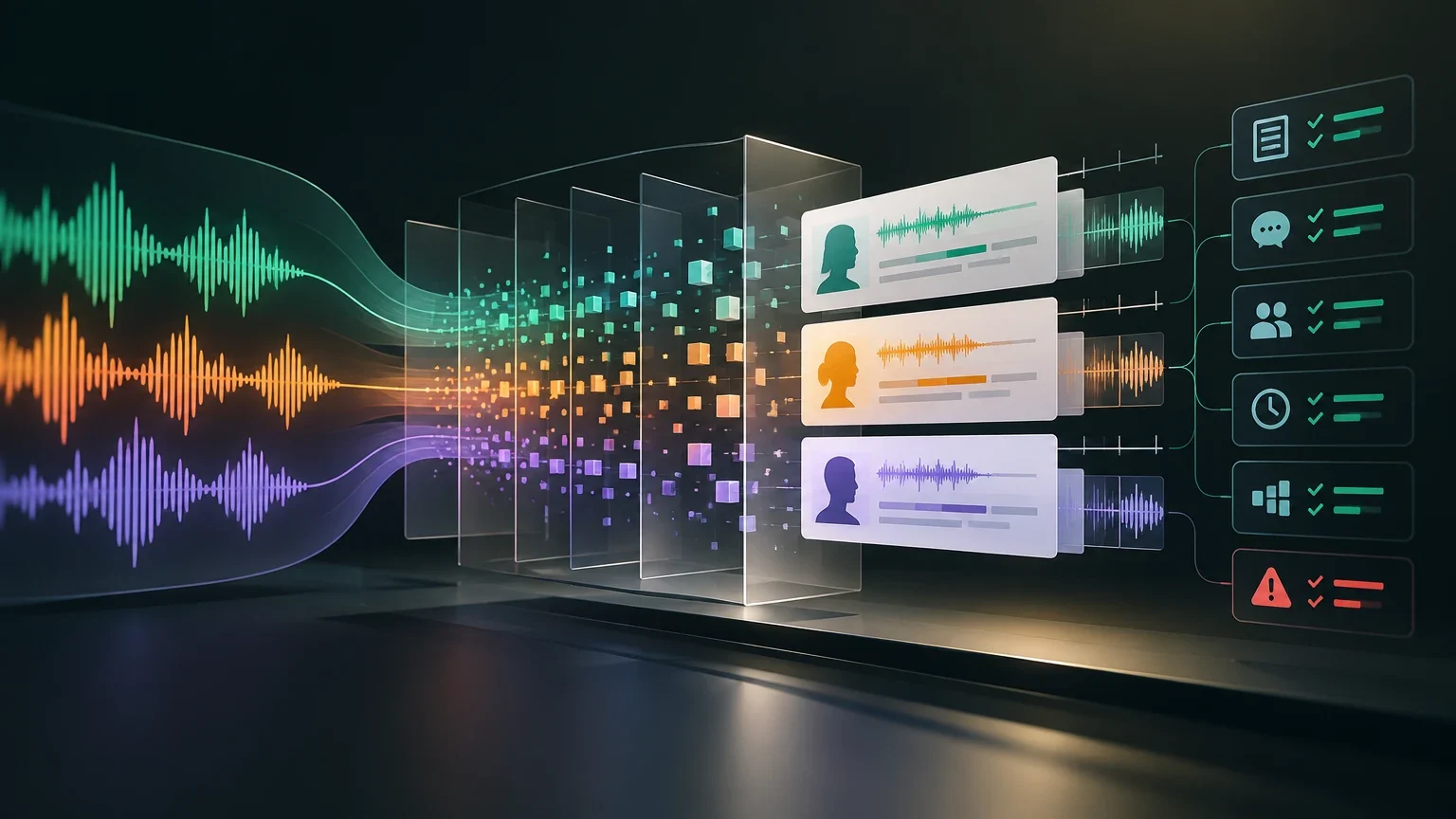
A useful automatic speech recognition evaluation cannot be reduced to a single accuracy percentage. This guide proposes a protocol for separately measuring text fidelity, critical entities, speaker attribution, timestamps, segmentation, and the validity of the output consumed by an application. The goal is to compare versions and configurations reproducibly, then decide with evidence when to promote, restrict, or block a deployment.
A guide to evaluating GPT‑Live‑1 in full-duplex voice conversations by separating turn dynamics, comprehension, task success, and the safety of delegated actions. It proposes a reproducible protocol using controlled audio, traces, temporal annotation, and blinded human review.
Adopting Gemini does not, by itself, describe an architecture or an operational commitment. The same team may use a Google model through the Gemini API, AI Studio, Vertex AI, or a managed product, with identifiers, data controls, tools, and lifecycles that must be verified separately.
A generative edit that is useful in production is not validated merely because the requested change looks correct. This guide proposes treating every retouch as a preservation contract: define what may change, what must remain, how to measure it, and when to require human review.
A generated shot can be convincing on its own and still be unusable when edited with others. This guide proposes a protocol for evaluating visual, spatial, and narrative continuity in generative-video sequences, recording their traceability, and deciding which clips are approved, which require intervention, and which must be discarded.
Claude Fable 5.1 should be evaluated as an execution contract, not as a capability label. This analysis separates what Google Cloud and Amazon Bedrock declare from what depends on the channel and what a team must measure before granting autonomy to a production workflow.
Claude Haiku 4.5 can be a destination for fast workloads after Claude Haiku 3.5 was retired, but a safe migration is not solved by changing an identifier. Documented minimum availability through October 15, 2026 does not guarantee indefinite continuity. The operational criterion is to demonstrate, using your own traffic and corpus, queue latency, schema compliance, tool use, and a reversible replacement path.
An observed improvement with Claude Opus 4.5 may come from the model, but it may also result from changes to context, tools, retries, or the verifier. This protocol helps separate those causes before expanding a deployment.
Mistral AI documents Voxtral TTS as a speech-generation service with streaming and several output formats. Before replacing a provider or model in calls, notifications, or published content, a team should verify not only audible quality, but also technical, operational, and data-contract compatibility through a regression suite using its own scripts.